Head to head
Synology DS423+ vs QNAP TS-233 (2026)
Four-bay Intel power against two-bay 2.5GbE value: which NAS philosophy fits your home?
#1 in our rankings · Best overall

Synology DS423+
Best for: Home users who want room to grow into Plex, Docker, and virtual machines.
#3 in our rankings · Best 2.5GbE value
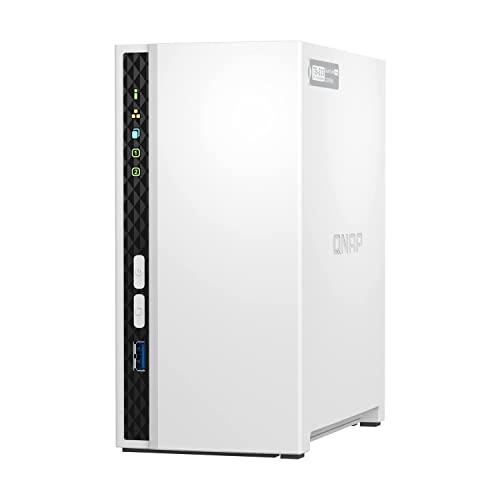
QNAP TS-233
Best for: Buyers who want faster-than-gigabit transfers without paying four-bay money.
Our recommendation
Recommendation: Buy the Synology DS423+ if you run Plex with transcoding, Docker, or a growing media library; its Intel chip, expandable RAM, and four bays are in a different class. Buy the QNAP TS-233 if your workload is fundamentally file storage and you want the fastest transfers for the least money.
Processing power
The DS423+'s Intel Celeron J4125 with Quick Sync hardware-transcodes video and runs containers and VMs; the TS-233's ARM Cortex-A55 is a file-serving chip. This is the difference between a NAS that hosts services and one that stores files.
Expansion
Four bays versus two is the obvious gap, but the subtler one is RAM: the DS423+ expands from 2 GB to 6 GB and adds NVMe SSD cache, while the TS-233's 2 GB is fixed forever. The Synology is built to grow; the QNAP is built to be enough.
Network speed
The TS-233's single 2.5GbE port beats the DS423+'s gigabit ports for single-client transfers, which is an odd inversion at these prices. The DS423+ counters with dual ports and link aggregation for multi-client households.
Choose Synology DS423+ if…
- You run Plex with transcoding or Docker containers
- Your storage needs will grow beyond two drives
- You want RAM expansion and SSD caching options
Choose QNAP TS-233 if…
- File storage and backups are the whole job
- You want maximum transfer speed per dollar
- Two bays and fixed specs are genuinely enough
Spec-by-spec comparison
| Spec | Synology DS423+ | QNAP TS-233 |
|---|---|---|
| Price tier | Premium | Mid-range |
| Drive bays | 4 | 2 |
| CPU | Intel Celeron J4125, quad-core (2.0 GHz base, 2.7 GHz burst) | ARM Cortex-A55, quad-core 2.0 GHz |
| Memory | 2 GB DDR4, expandable to 6 GB | 2 GB (fixed, not expandable) |
| M.2 slots | 2x 2280 NVMe for SSD cache | — |
| Network | 2x 1GbE RJ-45 with link aggregation | 1x 2.5GbE RJ-45 |
| Operating system | — | QNAP QTS 5.x |
| Best for | Home users who want room to grow into Plex, Docker, and virtual machines. | Buyers who want faster-than-gigabit transfers without paying four-bay money. |
| Skip if | You only need basic file storage; this is more NAS than that job requires. | You prefer Synology's DSM software polish over QNAP's more technical QTS. |
Strengths and limitations
Synology DS423+
Strengths
- Intel Celeron J4125 with Quick Sync enables hardware-accelerated Plex transcoding
- Two M.2 NVMe slots let you add SSD cache without sacrificing a drive bay
- RAM expands from 2 GB to 6 GB, and DSM supports Docker and VMs for tinkerers
Limitations
- Costs notably more than two-bay rivals before you buy a single drive
- Still limited to 1GbE ports; no 2.5GbE despite the premium positioning
- Synology's verified-drive lists can push buyers toward pricier first-party drives
QNAP TS-233
Strengths
- A 2.5GbE port delivers up to 2.5x the theoretical throughput of gigabit rivals
- 2 GB of RAM doubles the DS223j, helping with multitasking and apps
- QTS supports snapshots and a wide app center for backup and media duties
Limitations
- RAM is fixed at 2 GB with no expansion slot
- ARM processor limits virtualization and some heavier QTS applications
- QTS is powerful but less hand-holding than DSM for absolute beginners
How they fit the wider field
- Synology DS423+: ranked #1 (Best overall) in The Best NAS Devices of 2026. Read the full Synology DS423+ review.
- QNAP TS-233: ranked #3 (Best 2.5GbE value) in The Best NAS Devices of 2026. Read the full QNAP TS-233 review.
Neither one quite right? The full rankings cover 10 picks matched to different buyers.
Made your call?
Questions, answered
Is the DS423+ worth roughly twice the price?
For Plex transcoding, Docker, or growth beyond two drives, yes. For pure file storage, no: the TS-233 does that job as fast or faster for less.
Can either unit do 2.5GbE and transcoding?
Not in this pair. That combination lives in higher-tier models like QNAP's x86 2.5GbE units or Synology's Plus series with add-in cards, at higher prices.